How Nature Has Influenced Architecture Throughout History
- Emily Black

- Jul 17
- 6 min read
Updated: 7 days ago

I have always been drawn to architecture. From writing school essays exploring how nature influenced Antoni Gaudí’s designs, to studying textile design at University where I used architectural forms to create repeat patterns for fashion. Architecture has been a constant source of inspiration throughout my life.
Whenever I visit a new city, particularly in Europe, I find myself captivated by its exquisite buildings. Prague is one of my favorite places, where every street feels like stepping into a fairytale. I can spend hours admiring the intricate carvings, elegant forms and ornate details that decorate its historic buildings.
Art Nouveau and Rococo have long been among my favorite styles, while modern organic architecture continues to inspire me with its seamless connection to the natural world.
The more I have studied architecture and plants, the more I have realized that they share a common language of structure, rhythm and form. This post explores how architects have looked to botanical forms for inspiration throughout history and why that same way of seeing continues to shape my own artwork today.
Nature In Ancient Greek Temples

Although nature has influenced architecture since the earliest shelters were built using materials found in nature, I want to focus on its decorative influence.
Ancient Greek architecture provides some of the earliest and most remarkable examples of organic forms shaping architectural design.
The ‘Temple of Olympian Zeus’ in Athens, Greece (completed in AD132), is a great example of this. Its grand corinthian columns (pictured above) stand at an impressive 56 feet tall and were inspired by the beauty of the natural world. They are decorated with acanthus leaves, a Mediterranean plant known for its deeply curved foliage. These stylized carvings came to symbolize endurance, immortality and rebirth, while also representing the connection between nature and humanity. Originally, the temple featured 104 towering columns, creating a space that has often been compared to walking through a forest of giant trees.
The temple was inspired by nature not only through its decorative details, but also through its construction, using marble quarried from Mount Pentelicus in Greece.
Another notable building is the ‘First Temple of Hera’ at Paestum in southern Italy, built around 550 BCE. Hera, the Greek goddess associated with women, marriage and childbirth, was also closely connected with fertility and the natural world. Its sturdy Doric columns (pictured below) have an unusual profile, widening towards the base in a way that has often been compared to the trunks of ancient trees.

Many of the temple’s decorative details have unfortunately been lost over time. However, evidence suggests that the moldings between the columns were once adorned with leaf-inspired ornamentation. The roofline was also decorated with architectural terracottas (pictured below) and many surviving fragments feature beautifully crafted palmettes, lotus flowers and imaginative lion-head water spouts.

The Flourishing Beauty Of Rococo
Originating in France in the early 1700s, Rococo was an elegant and highly decorative style that became popular among the European aristocracy. Inspired by the beauty and movement within nature, it embraced flowing curves, asymmetry and intricate ornamentation. Narrow, floor-to-ceiling wall panels were richly decorated with carved scrolls, ribbons, shells, rosettes, tendrils and delicate botanical details; while windows, doors, fireplaces and mirrors were transformed into elaborate works of art.

Pictured above is the stunning ‘Queluz National Palace’ in Lisbon, Portugal. Its graceful architecture reflects the Rococo style’s love of organic forms, lightness and a close relationship with nature. Expansive windows flood the interiors with natural light while creating a seamless connection to the beautifully landscaped gardens beyond.
Another fine example of this elaborate style is ‘Claydon House’ in Buckinghamshire, England. Its remarkable interiors are filled with carved pine and plasterwork celebrating flora and fauna. The North Hall (pictured below) showcases lavish Rococo woodcarvings by the master carver ‘Luke Lightfoot.’ It features cascading garlands, flowing scrolls and incredibly lifelike foliage. Looking closely at these details, it’s easy to see how nature became not just a source of decoration, but a language that shaped the character and atmosphere of the space.

While the Ancient Greeks drew inspiration from the structure and symbolism of plants, Rococo designers celebrated nature in a far more expressive way; filling interiors with flowing botanical ornament that blurred the boundary between architecture and art. This fascination with the natural world would continue to grow, reaching its peak within the ‘Art Nouveau’ movement, where architecture itself began to imitate the graceful lines and organic forms found in nature.
Nature Comes Alive In Art Nouveau
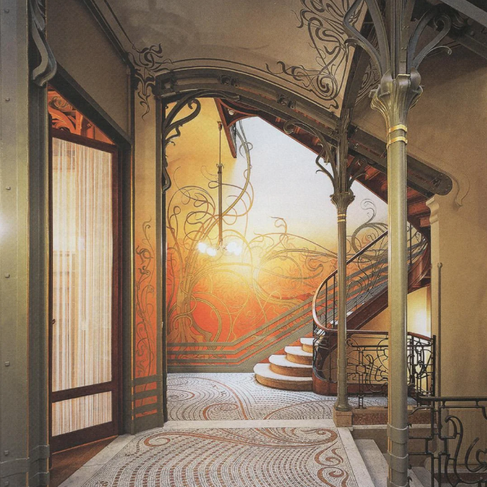
Popular between 1890 and 1914, Art Nouveau embraced flowing pattern and design shaped by the natural world. Characterized by its distinctive curves and sinuous lines, the movement celebrated nature in a way that no architectural style had before. It also coincided with advances in construction materials, particularly iron and glass, allowing architects to create fluid, expressive forms that had previously been impossible.
One of the finest examples is ‘Hotel Tassel’ in Brussels, Belgium (pictured below), designed by the architect ‘Victor Horta’. Its elegant facade softens the rigid appearance of neighboring townhouses with a broad, symmetrical bow window, while inside, the iconic staircase twists and flows like intertwining vines. Horta famously said, “Discard the flowers and leaves and take the stem”.
This is something I understand completely. In many of my own botanical illustrations, I find beauty in the less obvious parts of a plant. It isn’t always the vibrant bloom that captures my attention, but the graceful curves of a stem or the sculptural form of a leaf. These overlooked details often become the inspiration for my artwork.


Few architects embodied this philosophy more completely than ‘Antoni Gaudí.’ He believed there were no straight lines or sharp corners in nature and translated its structures, forms and rhythms directly into his architecture.
I often find myself approaching my artwork in a similar way. Rather than simply drawing a flower, I study the individual forms that make up each petal and leaf, following the flow of every line before creating the finished illustration.
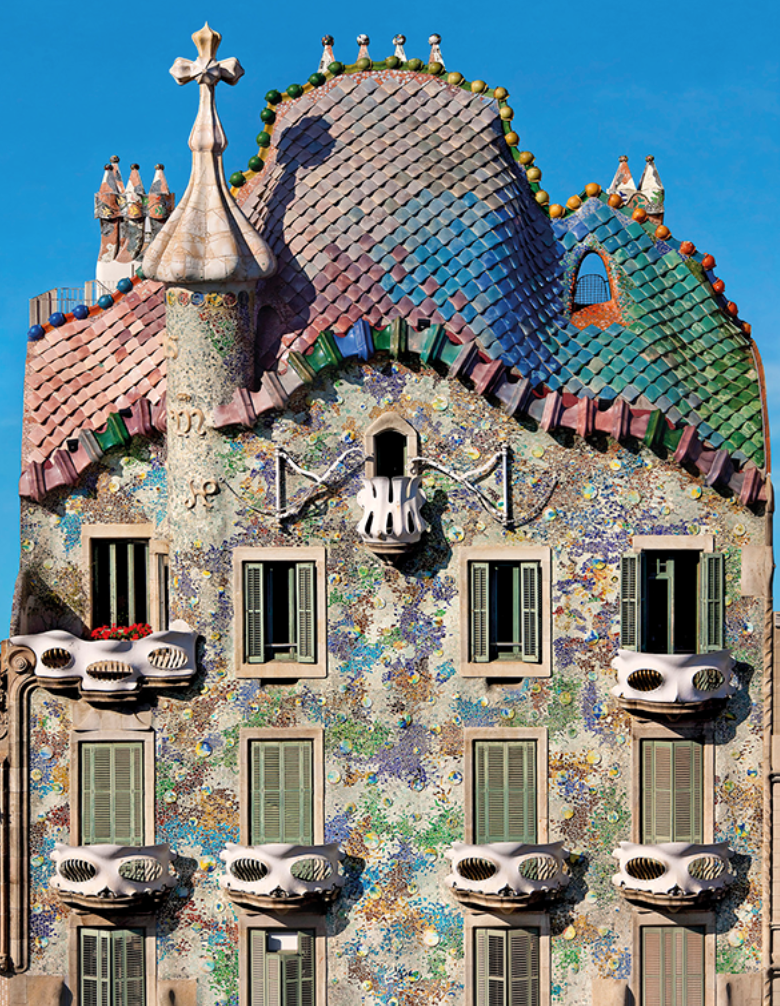
Gaudí looked beyond simply copying plants and animals. He studied the movement, geometry and structure of nature, allowing these principles to shape his buildings. This can be seen beautifully in ‘Casa Batllo’ (pictured below), whose shimmering facade resembles fish scales beneath the surface of the ocean. Inside, almost every surface flows with gentle curves, creating a building that feels as though it has grown rather than been built.
Perhaps Gaudí’s greatest masterpiece is ‘La Sagrada Familia’, where construction began in 1882 and continues today. Influenced by the forms of a forest, the soaring columns branch like trees, filling the interior with the feeling of walking beneath a woodland canopy. Sadly, Gaudí died before seeing his vision completed.
The Nativity facade, the only facade completed during his lifetime (pictured below), is covered with extraordinary carvings of local plants, birds, tortoises and other wildlife woven into religious scenes. Here, architecture, sculpture and nature become almost impossible to separate.


Coming Full Circle
My appreciation for historic architecture has always been about more than simply admiring beautiful buildings. It’s the craftsmanship, the thought behind every carved detail and the way architects captured the character of the natural world in stone, wood and plaster that continues to inspire me today.
In a world increasingly filled with mass-produced design and fast construction, I believe there will always be a place for carefully crafted work that tells a story. The buildings that have stood the test of time are often those created with patience, skill and a deep respect for both craftsmanship and nature.
Throughout history, our relationship with nature in architecture has continually evolved. Ancient civilizations celebrated its forms and symbolism, Rococo transformed flowers and foliage into elaborate ornament and Art Nouveau allowed buildings to flow with the graceful lines of plants and trees. Today, modern organic architecture has brought us almost full circle. Rather than simply borrowing nature’s beauty, architects are increasingly designing buildings that work alongside it, creating spaces that respond to their surroundings and exist in greater harmony with the natural world.
Perhaps that’s why I find so much inspiration in plants. When I draw, I’m not just illustrating flowers or leaves. I’m studying their structure and elegance, the very qualities that have inspired architects, artists and designers for centuries. In many ways, my botanical illustrations are simply another way of celebrating what nature has always been: the greatest designer of all.
Comments